



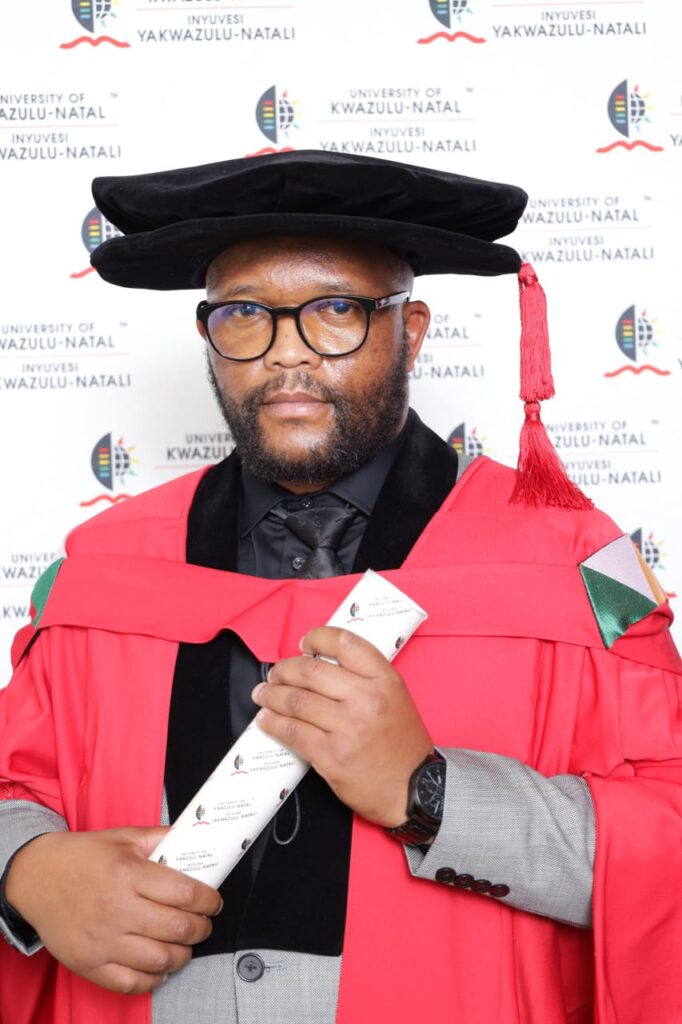



Siphelele Nketo
A COLLEGE manager has been awarded a Doctor of Philosophy degree in Educational Management, Leadership and Policy by the University of KwaZulu-Natal, after concerns raised about his matric qualification. Dr Bubele Nogcantsi, the acting campus manager at the Esayidi TVET College, Port Shepstone campus, believes that it better represents his potential.
Nogcantsi described the past years as the most difficult as he lost work, while having to provide for his family and pursue his studies at the same time.
Claims of not having a matric qualification were at the centre of his dismissal as the campus head of Esayidi TVET College, Kokstad campus in January 2023. However, he was reinstated into the institution in that same year as coordinator for the Community Development Centre (CDC).
After working as coordinator for CDC in Sizanani and Harding, in March this year, he got a new job as acting campus manager at the Esayidi TVET College, Port Shepstone campus. He joined the Esayidi TVET College as a junior lecturer at the Kokstad campus in 2008, and in 2016 he was promoted to the position of head of department for the civil engineering unit. In 2019 he was further promoted as campus manager.
He described his dismissal in 2023 as something that disrupted his life as he had to prove his innocence, not only to the institution but to society.
“Lies about my matric qualification were perpetuated by jealous individuals that were threatened by my education. Coping from that scenario was not easy, as I was even sceptical to go outside because some people believed that I did not have the qualification,” he stated, adding that having no work after dismissal gave him more time to focus on his studies.
In speaking about his journey towards his PhD he said it was challenging but at the same time exciting. He said the qualification was as a result of his hard work. He said his thesis dealt with stakeholder’s perspective on employability of TVET college civil engineering graduates. Part of his research findings identified gaps between the TVET colleges and employers, saying that it leads to a high unemployment rate of graduates.
He said the lack of partnership between companies and TVET colleges makes it difficult for graduates to survive under economic challenges. He called for TVET colleges to offer qualifications that are mostly relevant to the needs of their municipal jurisdictions. He said this would respond directly to the needs of the local community. He further challenged policymakers to force companies to employ skilled graduates to prevent a situation where a skill provided in a TVET college gets lost in the ‘mist’. In speaking about the advancement of technology, he emphasised a need for TVET colleges to adapt to change by modifying their curriculum. He cautioned that if TVET colleges failed to adjust to evolving technology, education will collapse.