
Siphelele Nketo
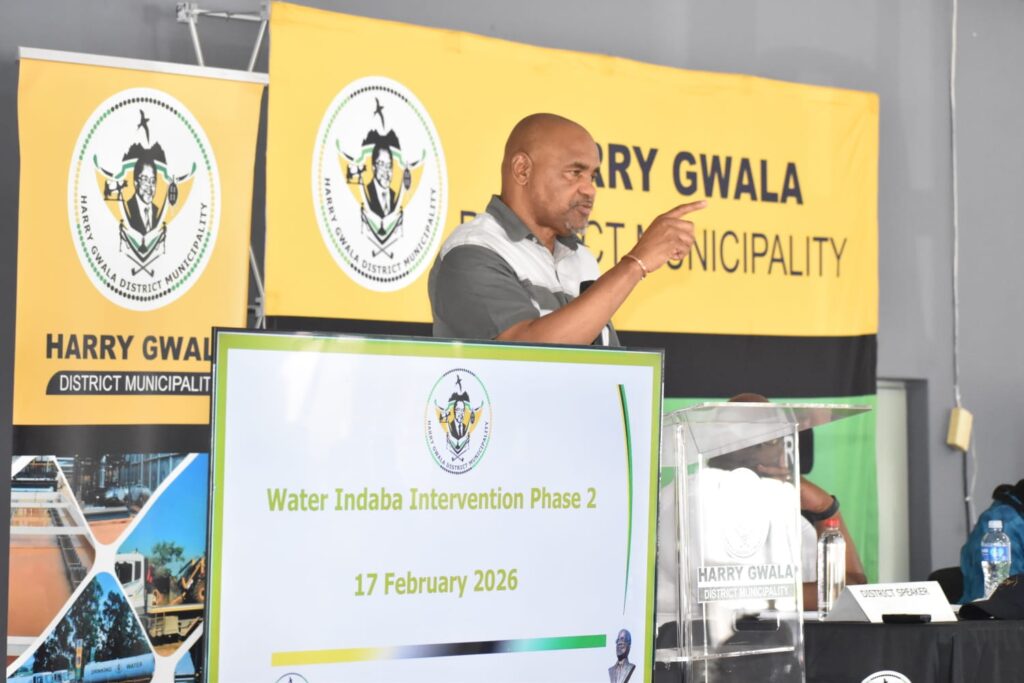
THE Harry Gwala District Municipality’s open council meeting this week served as a platform for Mayor Zamo Nxumalo to outline the municipality’s accomplishments since the current council assumed office in 2021.
On Tuesday, May 26, at Ofafa in Ixopo, Nxumalo tabled the municipal 2026/2027 draft budget and medium-term revenue and expenditure framework to a packed community hall.
He said that significant progress has been made across all local municipalities within the district since 2021, mentioning that major interventions have been implemented through the Emfuleni Creighton Water Scheme, the Khukhulela Water Scheme and the Centocow Water Scheme.
He said the projects continue to improve access to water for surrounding communities and strengthen long-term water supply sustainability. In speaking about sanitation challenges in Underberg and surrounding areas, he said that the district municipality has moved decisively.
“For many years, communities relied heavily on septic tank systems. Through this budget, sewer pump infrastructure will now be implemented to modernise sanitation services and improve environmental management,” he responded.
He said that substantial investments have been directed towards infrastructure development to support economic growth in the town of Kokstad. He said another investment went to residential expansion and long-term water security.
“We have overseen the handover of phases of the Bhongweni Reservoir Project to communities earlier this year. Additional phases of the Bhongweni and Shayamoya Reservoir Projects, together with smaller community-based schemes developed alongside communities such as Thuthukani in Ward 6, continue to improve access to reliable water supply,” he added.
He said the municipality is also implementing infrastructure investments in the district, mentioning the Kempsdale Dam Project. The project will increase water storage capacity and contribute towards water supply. He further mentioned the Mbizweni Sewer Project in Umzimkhulu to address sewer blockages and improve sanitation services. He said the project will soon be handed over to the community. He said the district municipality has drilled more than 216 boreholes to provide emergency relief to communities experiencing severe water shortages through the Water Indaba initiatives.
“In addition, the municipality procured 10 water tanker trucks to strengthen water distribution and emergency response capabilities and has further invested in TLB machinery and vehicles to strengthen infrastructure maintenance and operational efficiency across all local municipalities within the district,” he stated.
According to Nxumalo, the total consolidated budget for the 2026/2027 financial year amounts to R1.076 billion, while the parent municipal budget amounts to R1.049 billion.
He said the budget is primarily funded through government grants and subsidies, including the Equitable Share, Municipal Infrastructure Grant, and Water Services Infrastructure Grant.
“Operational grants and subsidies amount to over R609 million, while capital grants and subsidies amount to approximately R328 million. Our own revenue is projected at R138 million consolidated, generated largely through water and sanitation services, interest on investments and debtor collections,” he added and acknowledged the water and sanitation infrastructural challenges. He said that communities continue to experience water interruptions, ageing pipelines, leakages, insufficient bulk infrastructure, sanitation backlogs and the growing impact of climate variability and drought conditions